Open Interaction Band Series
Open Interaction Bands
Hand-intent recognition powered by our neural-sensing silicon and efficient edge computing—making natural gesture interaction immediately accessible.
- 6-channel high-density EMG capture fused with a high-precision 6-axis IMU
- Millisecond-level latency for pinch and fingertip micro-motion recognition
- No gesture calibration or training, with population-wide generalization
- Fully flexible 25 mm-wide, 3 mm-thick strap with rounded electrodes
- Low-power Bluetooth HID for phones, computers, smart terminals, smart glasses and VR devices
- Compatible with Windows, Android and iOS
- Open data interfaces and SDKs for force, pose, secondary development and custom mappings
Open interaction capabilities
- M1 maps natural gestures to mouse input for Windows and cursor-driven interfaces.
- T1 maps gestures to touch input for iOS and Android phones and tablets.
- K1 provides a larger keyboard-like mapping vocabulary for terminals and simple page control.
- D1 streams raw 2 kHz EMG and 6-axis IMU data for custom model training and deployment.
Selection table
| Product model | Open Interaction Band M1 v0.8 | Open Interaction Band T1 v0.8 | Open Interaction Band K1 v0.8 | Open Interaction Band D1 v0.8 |
|---|---|---|---|---|
| Product image | 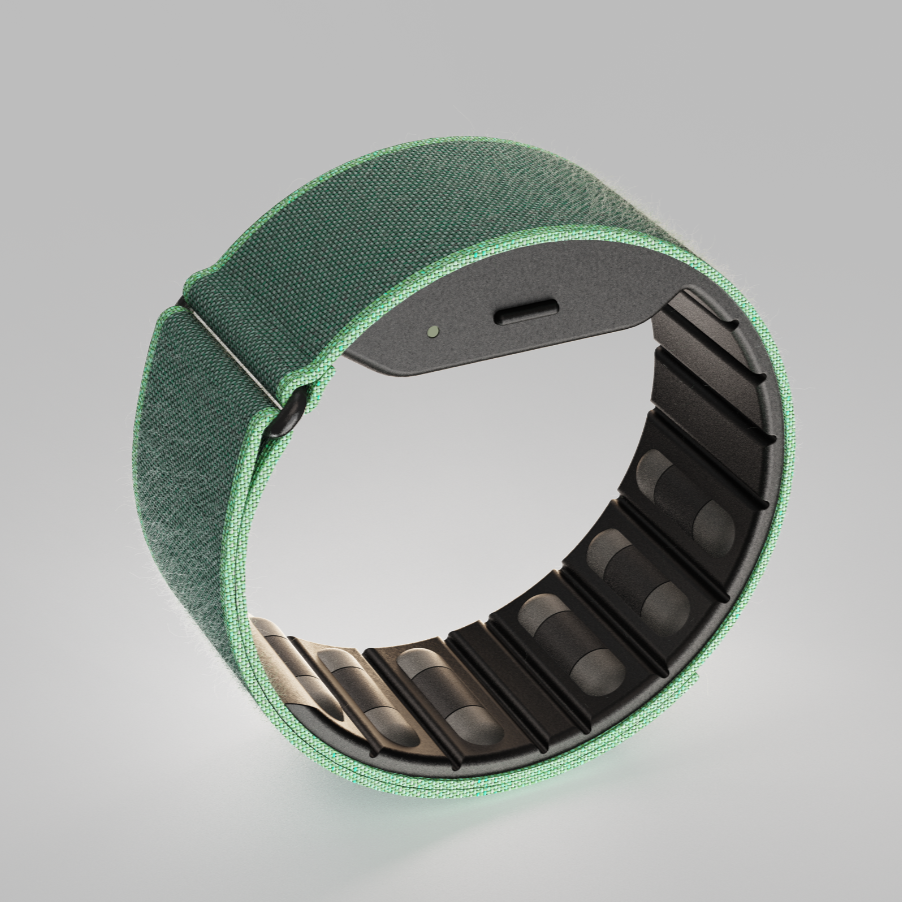 | | | |
| Description | An EMG neural band with on-device gesture recognition. It requires no gesture training or calibration and works immediately after fitting. Recognized gestures are transmitted through Bluetooth HID. | An EMG neural band with on-device gesture recognition. It requires no gesture training or calibration and works immediately after fitting. Recognized gestures are transmitted through Bluetooth HID. | An EMG neural band with on-device gesture recognition. It requires no gesture training or calibration and works immediately after fitting. Recognized gestures are transmitted through Bluetooth HID. | A raw-data EMG neural band that streams original muscle signals over Bluetooth for gesture-data collection and model training. |
| Hardware | 6-channel EMG 6-axis IMU | 6-channel EMG 6-axis IMU | 6-channel EMG 6-axis IMU | 6-channel EMG 6-axis IMU |
| Function | Mouse mapping On-device gesture compute with fingertip click, double-click, pinch and pinch-drag primitives | Touch mapping On-device gesture compute with fingertip tap, double-tap and pinch-drag primitives | Keyboard mapping On-device gesture compute with click, double-click, pinch-drag and joint-trigger primitives | Data passthrough No on-device gesture compute |
| Sensitivity | 5 levels | 5 levels | 5 levels | — |
| Selection guide | M1 and T1 use fewer gestures but respond quickly and provide high sensitivity with cursor control. M1 feels closer to a mouse and suits Windows; T1 feels closer to touch and suits iOS and Android. K1 provides more, more distinctive gestures than M1, with a lower response speed and keyboard-like mapping for simple page functions. D1 performs no edge inference. It is a passthrough device for customers building their own gesture-recognition model in an app. | |||
| Transport | BLE wireless HID | BLE wireless HID | BLE wireless HID | BLE wireless Custom protocol |
| Transmitted data | Mouse-mode HID reports plus a custom packet containing pose and force features | Touch-mode HID reports plus a custom packet containing pose and force features | Keyboard-mode HID reports plus a custom packet containing pose and force features | 2 kHz EMG data plus 6-axis IMU data |
| Target devices | Windows hardware | iOS and Android phones and tablets | Bluetooth HID devices including phones, tablets and smart glasses; iOS, Android and Windows | Phones, tablets and smart glasses supporting the custom data protocol; iOS, Android and Windows |
| EMG acquisition | Waveletech Galvani neural-sensing and compute silicon | Waveletech Galvani neural-sensing and compute silicon | Waveletech Galvani neural-sensing and compute silicon | Waveletech Galvani neural-sensing and compute silicon |
API Documentation
The GitHub documentation URL will be added here. The link is intentionally empty for now.
API Documentation↗